The question underneath the question
Every November I sit down with my list and do my year-end emotional reconciliation. I celebrate the wins. I adjust what fell short. And every year, a familiar voice shows up with the same line.
"You should have started earlier."
If you're 55 and you haven't started investing yet, that voice is probably loud right now. It speaks up the moment you read the word "retirement." It shows up when a friend mentions her portfolio. It sounds a lot like regret.
So let's answer the question you came here with. Is it too late to start investing at 55?
No. And I'm going to show you the math, step by step, so you never have to take my word for it.
The real question sits underneath that one. "Did I miss my chance?" You didn't. You have more time, more earning power, and more tools than that voice wants you to believe.
You are far from alone
If you feel behind, you're in very good company. Women everywhere are naming the same regret right now.
In a 2026 survey of 601 women by WealthWave, 40% said they regret not saving or investing sooner. Nearly two-thirds wished they had started earlier or understood money better.
An AARP poll from February 2026 found that just over half of women 50 and older feel worse off than they did a year ago. Only 11% feel very confident they'll have enough to live comfortably in retirement.
And here's the gap that tells the whole story. A Vanguard survey from April 2026 found that 71% of women feel confident saving money. Investing is where that confidence drops away.
Pause on that for a moment. You already know how to save. You've been doing it for decades, through school fees, groceries, emergencies, and everything life handed you. Investing is simply the next skill, and skills can be learned at any age.
The math, one step at a time
Let's take one simple example and walk through it together.
Here are the assumptions. You invest $500 a month in a fund that tracks the S&P 500, the 500 largest companies in the US. Your money earns an average of 10% a year, added in small pieces each month. You keep investing until age 70.
Where does 10% come from? Since the late 1920s, the S&P 500 has returned roughly 10% a year on average, with dividends reinvested. That's before inflation, which brings it closer to 7%. Some years are far higher and some are negative, so 10% is a long-run average, never a promise.
Now let's start at 55.
Months of investing. From 55 to 70 is 15 years. 15 × 12 = 180 months.
Money you put in. $500 × 180 = $90,000.
Balance at 70. About $207,235.
Growth earned. $207,235 − $90,000 = $117,235.
That $117,235 is money you never had to earn at a job. Your money earned it for you. For every dollar you put in, it added about $1.30 of growth. Your money more than doubled.
Here is the same plan started at three different ages.
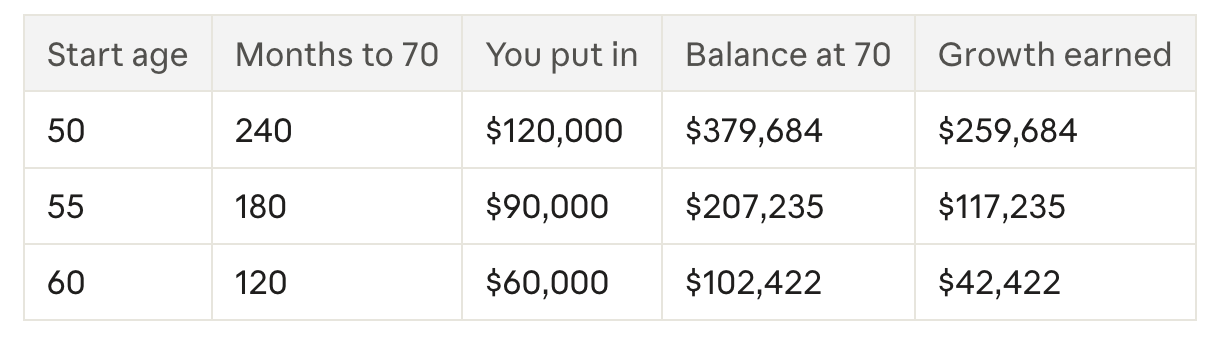
Yes, starting at 50 builds more. Starting at 55 still builds over $200,000. Starting at 60 still turns $60,000 into $102,422. Every row in that table is a woman who is better off than the woman who waited.
And 70 is far from the finish line. According to the Social Security Administration's life table, a woman who is 55 today can expect to live about 29 more years, into her mid-80s. The money you invest at 55 can keep working for you for decades.
What you have at 55 that you didn't have at 30
The voice in your head only counts the years behind you. Let's count what you're holding right now.
Bigger contribution room. The IRS lets you put more away once you turn 50. In 2026, you can contribute up to $24,500 to a 401(k), plus an $8,000 catch-up, for a total of $32,500. Between ages 60 and 63, the catch-up rises to $11,250. In an IRA, the 2026 limit is $7,500, plus a $1,100 catch-up, for a total of $8,600. Canadian readers, your TFSA and RRSP give you room to work with too.
Earning power. For many women, the 50s are strong earning years, and some of the big costs of earlier decades have eased. That's money you can direct on purpose.
Experience. You've lived through recessions, layoffs, divorces, and recoveries. You know that hard seasons end. That patience is exactly what investing asks of you.
A long runway. Your money doesn't need to sit untouched until you retire and then vanish. Most of it can keep growing through your 60s, 70s, and beyond, as you draw a little at a time.
Quiet the voice, then start
The math was never the hardest part. The hardest part is the voice that says "you should have known better" every time you open your banking app.
I know that voice well. Part of my own money story is a critical voice I inherited from my mother, and I'm still working on my perfectionism. These days that voice is quiet, since I have the tools to settle it. That quiet gave me room to put my money plan into action and let it build.
That's why The Wealth Shortcut starts with you, before a single number. We explore what you value and why, and we calm the old money stories in your body. Then the plan has room to work.
Here are four first steps you can take this month.
Find out what you already have. Look up any workplace plan, old account, or savings you've been avoiding. Write the numbers down. They're simply where you begin.
Pick an amount you can keep up. $100 a month counts. $500 a month counts. The amount you'll stick with is the right one.
Choose something simple. Rule 8 of No Regret Money Rules says never invest in anything you can't explain in a sentence. A low-cost, broad market index fund is easy to explain.
Set it up to run on its own. Automate your monthly amount, then let time do its work.
Resources to keep you going
No Regret Stock Investing for Women walks you through investing from your very first share, with every number explained.
No Regret Money Rules gives you the rules I wish someone had handed me decades ago. [link]
How to Do Self Love helps you rebuild the self-worth that the inner critic chips away at. [link]
You didn't miss your chance. Your chance is today, at 55, with everything you know now.
Ready to make your money work for you? Attend my Free Financial Freedom Class. I'll walk you from money anxiety to a funded life, step by step.
Save my seat in the Free Financial Freedom Class
This post is for education only and isn't personal financial advice. The 10% return is a long-run historical average, before inflation, and an illustration only. Investing carries risk, and past returns don't guarantee future results.